Aaron Dworkin - Founder and President, The Sphinx Organization
This past week I had the privilege of attending a concert at Carnegie Hall. It is always a privilege to attend almost anything at Carnegie Hall, so rich in all its tradition, but what made this particular evening a particularly special one is that The Sphinx Laureates were playing!
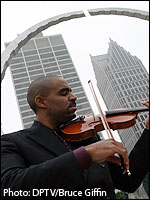
Aaron Dworkin founded the Sphinx Organization thirteen years ago as a result of his commitment to provide an opportunity to Black and Latino kids to learn how to play the string instruments, to prepare them to play professionally and to expand the opportunities available to them, on a global level. What he has created, along with his faculty and staff is breath taking and the pleasure to continue to participate with them –
is all mine.
DR: What is it like for you, after you have worked so hard, to finally be standing in the wings at Carnegie Hall, watching it all come together so beautifully?
AD: At times it is tough to hold back such intense emotion.
It is the realization of, not just all of our hard work as an organization, but all of the hours and hours that the individual musicians spend practicing as well as the Harlem Quartet and the chamber orchestra and knowing that there is a packed house out front full of people who are enjoying the music as well as industry leaders who are going to be able to positively impact their professional careers. It's emotional on a lot of levels.
DR: Sphinx is thirteen years old and yet the organization feels a lot more mature than that. Why do you think that is?
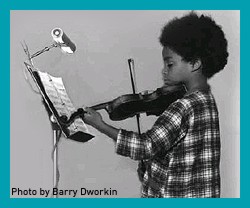
Aaron Dworkin practicing his violin playing as a child.
AD: Well, two things.
The first is just the amazing level of commitment from all of the musicians that we work with. We take it very seriously when we provide them with resources and we make it clear to them that they need to make use of those resources. That is something that is very important.
The other thing is that I have been very lucky and I've made good choices in terms of staff. Sphinx has forty full and part time staff and faculty and they are really just some tremendous people. They are incredibly dedicated and talented. The organization has gone far beyond me and that makes me very happy. I am very excited about the many things that occur without my direct involvement and that is a testament to the incredible team that we have been able to assemble.
DR: What do you recall as a turning point moment, the moment when you felt that Sphinx was going to be an organization that would remain?
AD: What's interesting is that I have always believed that we would be remain, from the get go. Even before we existed, and even when things could have easily fallen apart.
Certainly, I would have to say, that one of the major things that occurred recently was this million dollar commitment that we have received from JP Morgan Chase. In addition to the multi-year nature of their contribution, there was also logistical support that they brought. Just having one of the largest financial institutions in the world partnering with us, sends a signal to other funders that:
"Sphinx is not some fledgling or intermediate organization. Sphinx is a major institution in the field of classical music and one that we should join our peers at JP Morgan Chase in supporting them."
That, in many ways, helped to solidify what was already occurring.
Over the last two years we have worked very hard in terms of our internal infrastructure at Sphinx. There was a time when a paper clip didn't get attached without my direct involvement and that has significantly changed. We have some key people, and of course Tonia McGee who is our Executive Director in kind of the COO capacity, who have demonstrated incredible leadership and it has just transformed the organization.
DR: The last time we talked you were sharing with me how persistent you have to be...
AD: Oh yes - everyday!
One of our biggest problems is that we are still far from being able to meet all of the demands of our program. There is a demand for us to expand the educational work that we are doing, not just in Detroit but in New York, in Atlanta, in Miami and in Chicago and it is really a matter of having the resources to be able to do that. We have a vision to bring the Sphinx Chamber Orchestra on tour next year. We are working on that. Even internationally there is a growing demand for our programs. So, our only limitation now, is the resources.
DR: For those people who have never heard of Sphinx and are being introduced to you for the first time, what would you like them to know about the organization?
The Sphinx Chamber Orchestra and Harlem Quartet make their triumphant return to Carnegie Hall’s Stern Auditorium on the evening of October 7, 2009 in a concert highlighting works by composers of color.
The event, chaired by Sheila C. Johnson, will also feature the presentation of the Sphinx Lifetime Achievement Award to Roberta Flack, the renowned songstress and music education advocate. This marks the fifth appearance of the Sphinx Chamber Orchestra, an ensemble comprised of Laureates of the Sphinx Competition for Black and Latino string players, and the Harlem Quartet, whose previous sold-out performances have earned rave reviews in The New York Times.
The Sphinx Organization is the national nonprofit organization committed to building diversity in classical music and proudly presents the concert at Carnegie Hall as a part of the Sphinx Chamber Orchestra’s second national tour. The Orchestra is performing across the country on an expanded tour with 13 stops between California and New York City.
“In the past five years, Sphinx has given dozens of young musicians the opportunity to perform on one of the world’s great stages, and we have shared their talent with thousands of young people from the New York area,” said the Sphinx Organization’s Founder and President Aaron P. Dworkin of the Sphinx Artist Series at Carnegie Hall. Dworkin founded the organization in 1996, and was awarded a prestigious MacArthur Fellowship in 2005 in recognition of his work in bringing diversity to classical music.

AD: Well I would like for them to know that there is an incredible under representation of Blacks and Latinos in classical music, and Sphinx is, unfortunately the only major national organization that exists to address that need and to address providing early music education and development to under served use across the country.
Another thing that is very important to know is that, regardless of whether a young person ends up going into a professional career in music or not, the benefit of early classical music instruction and study has been proven far and wide. When we limit our children's access to this type of training, it impacts, not just the breadth of their experience and their cultural appreciation and quality of life, but it also impacts their ability in terms of math scores and other academic fields and goal setting and discipline. All of those other academic areas are incredibly enhanced by the study of an instrument at a young age. This work is critical and I just want to impress upon people that if they have resources that would benefit Sphinx, to consider contributing to the work that we do, or if they have a direct role that they could play as a teacher or an educator or a musician - I would ask that they consider us.
DR: I was watching a documentary not too long ago, about a dog kennel in a small town in Arkansas, where the dogs were being horribly abused and one of the first thoughts that I had as I was watching is "I bet that there are no music programs there" because I saw no beauty there...
AD: It makes a huge difference!
If a young person is playing the violin and getting together on a Saturday to play chamber music, chances are they are not out there gang banging...
DR: Ya know...
AD: ...or shooting dogs.
There is a quality of life that comes with music and we need that vibrancy. When I had hardships growing up, I needed to express my feelings and when you do that through the arts and through music it can actually be beautiful, whereas, you otherwise, as a young person seek out other ways to express yourself and often times that can be incredibly negative. The arts is something that enhances other people's lives.
DR: I was just telling my daughter the other day to practice her violin and she got a little bit annoyed and so I shared with her that I think it is a privilege to be able to speak the language of music. It is an extraordinary way to communicate. As I watched your kids playing at Carnegie Hall I thought "Wow! If I could only do that. If I could play like that!"
AD: Exactly.
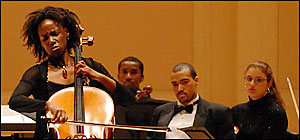
DR: One of the things that I was thinking after hearing Tahirah Whittington play her cello solo was what a tragedy it would have been for someone not to have found her and put a cello in her hand. What do you think it means to a kid like her, personally, or to her community directly, to be able to do what she does? She is someone to be proud of, for sure.
AD: Absolutely! And, that pride is multiplied by all of the musicians on stage and our conductor, Chelsea Tipton. I was sitting in a box with Chelsea's parents and when it was over the pride in their faces was just incredible. It was wonderful. Tahirah is just one of those incredible musicians and I think that it is incalculable, the impact that this has on her family. Her life now is making music. That is the job that she gets to go to everyday.
DR: Is there anything else that you want people to know?
AD: We now have New York offices and so we are growing. We are planning a tour for the chamber orchestra and the quartet next year. And, of course I would like to mention how much we appreciate the support and partnership of JP Morgan Chase.
The reality is that we would not have been able to have this Carnegie Hall series without them.
Tickets for the Carnegie Hall Concert

TICKETS FOR THE CARNEGIE HALL CONCERT
DATE: Wednesday, October 7, 2009
TIME: 6 p.m.
COST: $20
TICKETS: Carnegie Hall Box Office at (212) 247-7800 or carnegiehall.org
Information regarding SPONSORSHIP OPPORTUNITIES AND VIP ARRANGEMENTS are available through the Sphinx Organization by calling Marshay R. Williams at (646) 429-1987, ext. 713 or emailing marshay@sphinxmusic.org
The Sphinx Laureates at Carnegie Hall is presented with generous support from Chase, Bloomberg, and Sheila C. Johnson.
The Sphinx Chamber Orchestra Tour is made possible by the Andrew W. Mellon Foundation. Support for youth and community programs through Musical Encounters-The Tour! provided by Target.